

Storytelling: Backstory
Backstory is the invisible scaffolding of a character.

Please note, this post contains spoilers for the following: Star Wars, The Godfather, and Hamlet.
Ever met someone who instantly fascinated you, not because of what they said, but because of what they didn’t?
They drop a casual line like, “Yeah, I used to live in Croydon,” and suddenly your brain is racing: why Croydon? What happened there? Who were they then, and who are they now?
You lean in, hungry for the details, because mystery is magnetic, and anyone who chooses to live in Croydon must have an intriguing reason.
That’s the power of backstory in storytelling. It’s the hidden history that makes a character feel like they existed before page one. It’s the story before the story. When done right, it makes us curious, keeps us guessing, and makes us care.
What is Backstory?
Backstory is the invisible scaffolding of a character. It’s everything the storyteller knows about them — their childhood, their heartbreaks, their triumphs, their failures — even if most of it never makes it onto the page or screen.
The key thing to remember is this: every character has a backstory.
One-dimensional characters may only need a sliver of it. The guard who gets knocked out might have a family waiting at home, even if we never see them.
Two-dimensional characters carry richer histories that inform their quirks and contradictions. Sherlock Holmes’ eccentricities, for instance, feel rooted in a life we don’t fully know but can sense.
Three-dimensional characters thrive on backstory. Their arcs are powered by the weight of what came before. Luke Skywalker’s longing for adventure makes sense because we know he grew up stuck on a desert farm. Michael Corleone’s tragic fall resonates because we understand the values he started with as a war veteran.
Backstory isn’t about dumping information. The audience doesn’t need to know everything, but you, the storyteller, do. Because when you know where your character has been, you’ll understand why they act the way they do.
If you really want to see backstory in action, look at actors. We probably understand it better than writers.
Every role, no matter how small, demands a history. Even the barista who mutters, “That’ll be five-fifty,” has a life beyond the counter. Did their alarm go off late? Did they sprint to catch the bus? Did they leave the stove on at home and spend the whole shift worrying about it?
None of that is in the script, but all of it informs the performance. That’s because acting is another discipline of storytelling. To play a character truthfully, you need to know what they’ve lived through, even if the audience never hears about it. Writers can learn from this.
Backstory is the fuel that shapes how a character moves, speaks, reacts, and ultimately how real they feel. Think of it as the private diary your character keeps tucked away; the audience only gets to peek at a few selected entries.
Approaches to Backstory
Just as actors approach backstory differently depending on the role, writers have their own methods too. Some treat it like a secret vault, some like a sprawling family tree, and others like improvised notes scribbled on a napkin during tea breaks.
Broadly speaking, I like to categorise writers into three groups: the architects, the gardeners, and the minstrels.
Architects map out every detail before they even start the story. They like to document everything: childhood traumas, first crushes, favourite ice cream flavour, underwear colour, you name it, they’ve got it covered.
J.R.R. Tolkien famously created entire languages and histories for Middle-earth before The Lord of the Rings even began. This approach gives you a rock-solid foundation, but the danger is drowning yourself in the process.
On the other hand, gardeners plant a seed and let the backstory grow organically as they write. They like to discover their character backstories along the way.
George R.R. Martin calls himself a gardener; he lets his characters surprise him, and their pasts unfold naturally. This keeps the writing fresh, but it can run the risk of tying you in knots. This probably explains why it takes Martin so long to write A Song of Ice and Fire.
Borrowing from performance, minstrels sketch just enough backstory to inform behaviour. This type of writer cares less about a grand sprawling history and more about the immediate context.
Quentin Tarantino often drops characters into scenes with just enough implied history to make them pop (see: Winston ‘The Wolf’ Wolfe from Pulp Fiction). This approach is lean, practical, and keeps the focus on the present story, but it does run the risk of being too shallow if you never dig beneath the surface.
Each approach has its strengths. The architect ensures consistency, the gardener finds spontaneity, and the minstrel adds realism. The trick is knowing which method suits your story and sometimes blending them.
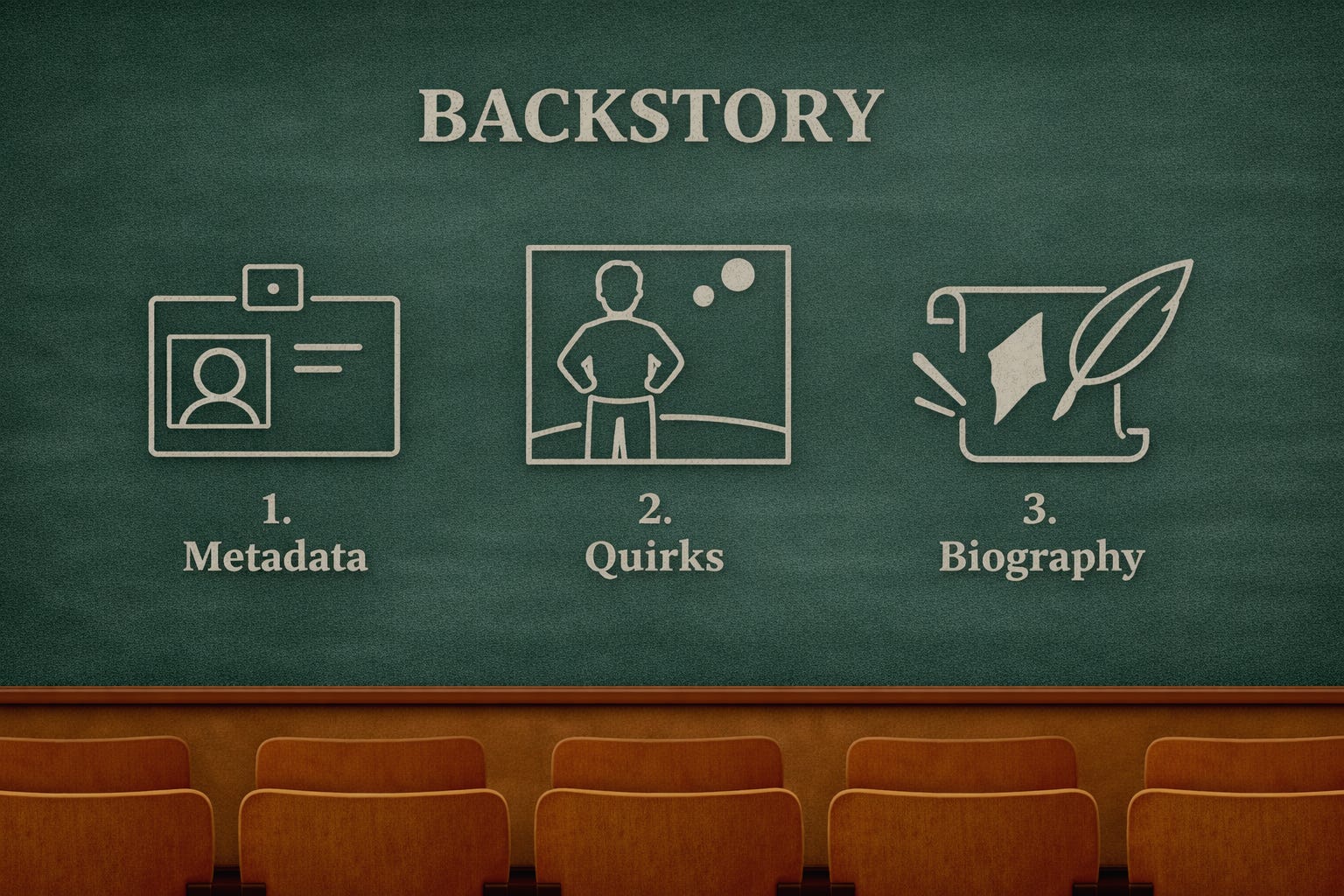
Backstory in Three Steps
Over the years, I’ve developed a quick and efficient way to sketch backstories without drowning in detail. It’s a three-step process that keeps things simple while still giving characters enough depth to build on when telling your story.
1. Metadata
First, begin with the metadata, the data about the data. They’re the basic facts that immediately place the character in a socio-cultural context. For me, these are class, ethnicity and occupation.
In fantasy, this might mean deciding whether your character is a ‘working-class dwarven blacksmith’ or a ‘middle-class dragon investment banker’ (because hoarding gold is basically finance). In contemporary fiction, it could be as simple as ‘middle-class Somali doctor’ or ‘working-class Turkish barber’.
Hamlet is an aristocratic Danish prince, and Luke is a working-class human moisture farmer.
Simply put, metadata are the basic ingredients. They tell us where the character fits in the world before the story begins, giving us a sense of who they are and the struggles they may face. They determine whether we’re cooking chicken tikka masala or baking an apple pie.
2. Quirks
Next, introduce character quirks that make the character unique. Everyone has quirks. They’re the little habits, contradictions, or eccentricities that separate one person from another.
For example, the working-class dwarven blacksmith etches poetry into his swords, and the middle-class dragon investment banker is terrified of thunderstorms.
Hamlet likes breaking into soliloquy, and Luke likes to watch the twin suns set over Tatooine.
Quirks are the spice. They add the flavour that makes the character stand out. Without them, there’s nothing to differentiate them from cardboard. And no one likes eating cardboard. Well, at least, anyone I know. Maybe that could be your quirk.
3. Biography
Finally, sketch a brief biography that leads into the main story. This biography should draw on the metadata and explain the quirks, but ultimately produces something called the ‘shard of glass’.
Coined by Blake Snyder, the shard of glass is that one unresolved issue, wound, or flaw the character needs to confront in order to truly change. It’s the thing that separates three-dimensional characters from their one-dimensional and two-dimensional cousins.
Our working-class dwarven blacksmith dreamed of being a poet but grew up in a family that mocked his artistic side. Etching poetry into the swords he forged was his only outlet. His shard of glass is family expectations.
Meanwhile, our middle-class dragon investment banker once lost a lot of money after investing in stocks for a shipping company. He’s terrified of thunderstorms because it was a thunderstorm that destroyed the shipping company’s main docks, plunging the dragon’s firm into bankruptcy. His shard of glass is trust in the capitalist system.
Luke dreams of becoming a pilot like his father before him. He stares at the twin suns because he yearns to explore the galaxy beyond his home. His shard of glass is a lack of purpose.
Hamlet’s father was murdered, and he suspects his uncle, who also happens to be his stepfather. He breaks into soliloquy time and again because he is reckoning with the philosophical quandary of what to do. His shard of glass is indecision.
Writing a character biography is the cooking process that brings together our basic ingredients (metadata) and spices (quirks) to create a tasty chicken tikka masala (character). The shard of glass is the one thing in our chicken tikka masala (character) that would harm our lovely guests.
We must make sure we remove the shard of glass from the chicken tikka masala during the dinner party (the character must overcome their shard of glass during the story). That way, when they finish eating our chicken tikka masala (character), they can leave satisfied (enjoy the story).
DISCRETIONARY NOTE: The author of this article does not condone cannibalism (unless that’s your quirk).
Beware of Backstory
Now, before you go racing off to write a ten-thousand-word epic about your protagonist’s childhood hamster, let me throw in a warning: don’t get too bogged down in the backstory.
Don’t believe me?
I once knew a guy who set up an entire wiki page for his novel. Every character had a detailed background, including those who didn’t even appear in the main story. He was an architect and would’ve definitely been best friends with Tolkien if he were still around.
Two years later, I bumped into him on the street and asked how the book was going. He still hadn’t started. I don’t know if he ever did. And that’s why I impose a harsh five-hundred-word (or one-thousand-word for sprawling high fantasy) limit on myself.
So yes, backstory matters, but don’t let it become your obsession. If you spend all your time writing the story before the story, you’ll never actually write the story itself.
Backstory is the soil from which your characters grow; it’s not the whole garden. It gives them roots, context, and hidden scars, yet the real magic happens when they step into the story and collide with plot, setting, and the other characters. That’s when they stop being outlines and start becoming people.
In the next post, we’ll dig into want, need, change, and theme. These are the forces that truly differentiate one-dimensional, two-dimensional, and three-dimensional characters. They are the engines of transformation, the reasons we care, and the heart of character-driven storytelling.
So, if you haven’t already, make sure to subscribe to Ghaniations to get the next chapter in this series delivered straight to your inbox.
Nicely written Aqil. One of my favourites is Slumdog Millionaire which is told through a series of flashbacks which essentially informs the present not sure if I’ve shown it to you yet.