

Storytelling: The Five-Act Structure
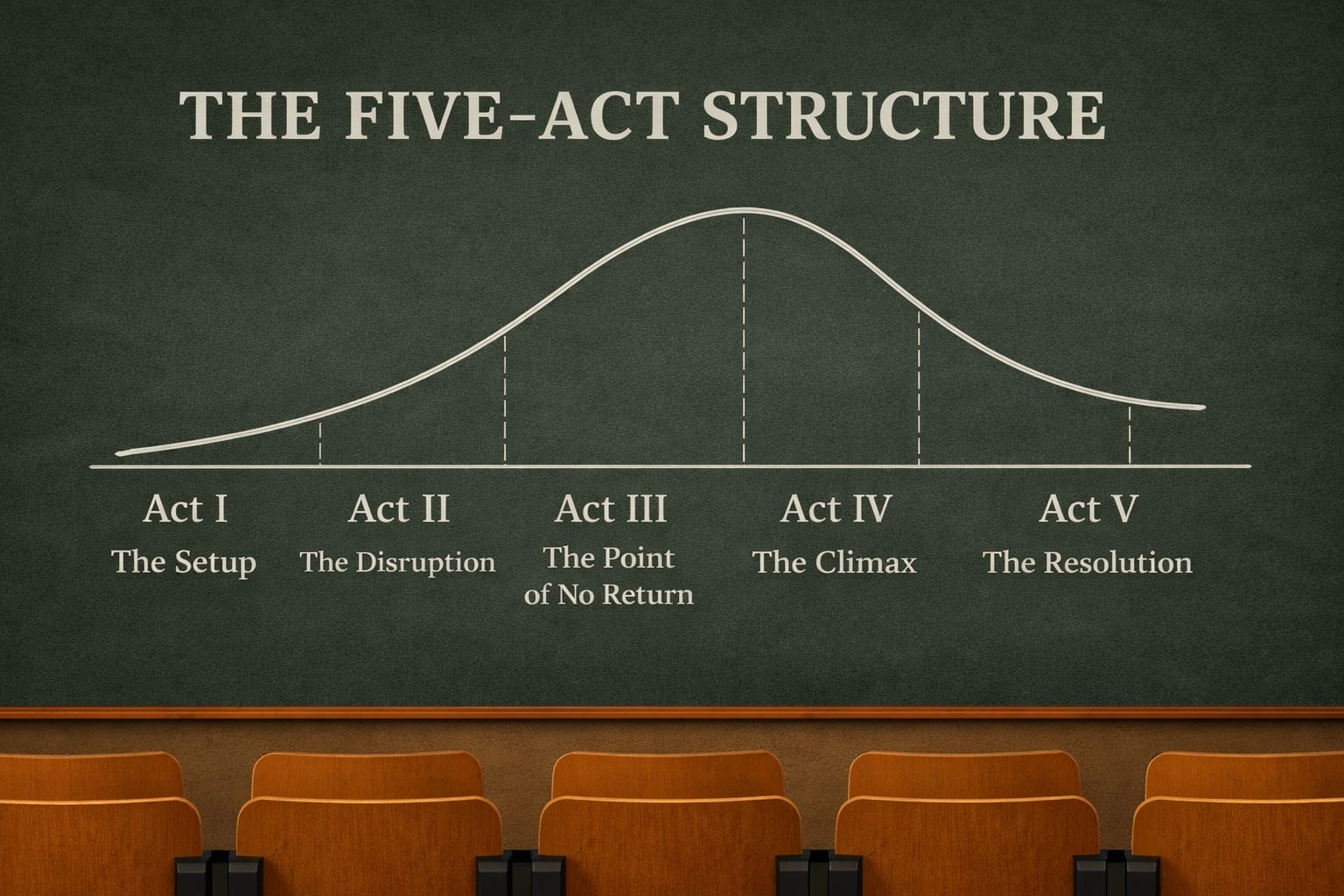
The Five‑Act Structure is a depiction of the natural shape that all stories take.

Please note, this post contains spoilers for the following: Star Wars, The Godfather, and Hamlet.
“It’s like poetry, it rhymes.”
George Lucas
Ever noticed how everyone instinctively knows when a story is being told well and when it’s being told like a drunk WhatsApp voice note at 3 a.m.?
You don’t need a degree in creative writing to feel it. When a story flows, you lean in. When it doesn’t, your soul quietly leaves your body.
We’ve all been trapped in those conversations where someone launches into an anecdote with the confidence of a seasoned bard, only to deliver a rambling saga with no beginning, middle or end, that still manages to include three unnecessary detours about their cat’s trip to vet, before suddenly declaring, “Anyway, that’s why I don’t trust escalators,” and walking off into the sunset.
You can’t explain why it’s wrong, but as you stand there watching them walk off towards the horizon, thinking this person has lost the plot, you vow never to lose it yourself.
That evening, you go home and search up Ghaniations so your boy, Aqil, can give you the lowdown on plot. Don’t worry, dear reader, I got you.
The Many Maps of Plot
The truth of the matter is that humans are wired for story. We know its rhythm the way we know when milk has gone off: instinctively, viscerally, and with a slight sense of betrayal.
Even the people who swear they don’t believe in plot still follow one. They just don’t realise it. Because plot isn’t some academic straightjacket, it’s the natural shape of every story ever told.
Imagine putting William Shakespeare, George Lucas, and Francis Ford Coppola in the same room and asking them to describe the shape of a story.
Shakespeare would probably break into soliloquy, Lucas would start going on about the rule of threes, while Coppola would pour a glass of wine and mutter something about disturbing him on the day of his daughter’s wedding.
Three wildly different storytellers, three wildly different vibes and yet, without realising it, they all paint the same instinctual shape we all recognise as story. They may use different brushes, they may use different colours, but the shape remains the same.
And this is where things get fun because once you start digging into storytelling, you quickly realise that every storyteller, theorist, and their mum has tried to map this instinctual shape. Entire industries have been built on giving the same pattern a fresh coat of paint.
Hell, I’m trying to do just that with this series myself.
You’ve probably heard at least one of these:
Hero’s Journey: Joseph Campbell’s mythic cycle, where the protagonist leaves home, faces trials, meets a mentor, confronts darkness, and returns transformed.
Save the Cat: Blake Snyder’s screenwriting checklist, which insists that your hero must do something adorable in the first ten pages or the audience will riot.
Story Circle: Dan Harmon’s eight‑step loop that basically says the character wants something, goes out to get it, pays a price, and returns changed.
Freytag’s Pyramid: The old‑school German model that looks like it was built by a pharaoh with a fetish for exposition, rising action, climax, falling action, and resolution.
Three‑Act Structure: The good old Hollywood classic of setup, confrontation, and resolution, tattooed on the souls of screenwriters everywhere.
But Western models aren’t the only game in town. Storytelling is a global language, and other traditions have been mapping it for centuries, too:
Kishōtenketsu (East Asia): A four‑part structure, including introduction, development, twist, and conclusion, that emphasises contrast rather than conflict.
Rasa (South Asia): Not a plot model per se, but a dramaturgical system built around the nine emotional flavours a story evokes in its audience.
Maqāma (West Asia): Episodic tales consisting of a narrator’s citation and their encounter with a roguish protagonist, followed by reward, recognition, reproach, justification, and farewell.
Griot Method (West Africa): Cyclical storytelling where repetition, call‑and‑response, and moral reframing guide the narrative arc, allowing for oral preservation.
Yoruba Itan (Nigeria): Stories structured around destiny, disruption, and restoration, often mirroring the spiritual journey of alignment with one’s inner purpose.
Sìdàmíngzhù Structure (China): Sprawling narratives built on rise, chaos, moral reckoning, and restoration, often mirroring dynastic cycles.
Jo-Ha-Kyū (Japan): A pacing model used in theatre, martial arts, and even tea ceremonies, consisting of a slow beginning, acceleration, and rapid finale.
Different continents, different philosophies, different vibes, yet the very same heartbeat. A beginning that sets the world, a middle that disrupts it, and an end that resolves or reframes it.
Whether you draw it as a circle, a wave, a pyramid, or a cat that desperately needs saving, you’re describing the same ancient rhythm that resides in every human soul. Truly, there is nothing that unites us as a species as much as storytelling.
That’s why arguing about which model is best is like arguing about whether biryani tastes better eaten with a fork, a spoon, chopsticks, or your hands. The utensil isn’t the point. The flavour is. Select whichever tool best helps you taste it.
As for me, the utensil I use to taste the biryani is the Five-Act Structure, as described by John Yorke in Into the Woods.
The Five-Act Structure
If you’ve ever opened a Shakespeare play and seen those neat little labels at the top going Act I-V, you might assume Shakespeare sat down and deliberately carved his stories into five perfect chunks. He didn’t.
The Five-Act Structure was part of a much older storytelling tradition, inherited from classical Greek and Roman drama, and later editors retrofitted Shakespeare’s plays into it when they were printed.
Yorke took that pattern and articulated it with a level of clarity that can’t help but make you go, “Oh, that’s what I’ve been feeling all along.”
Just like the other models discussed in this post, it too reflects the universal story shape.
Act I – The Setup
Every story begins in a state of balance. The protagonist’s world may not be perfect, but it is stable. This is where we meet the protagonist before the storm hits, when their life still makes sense to them, even if it’s incomplete or quietly unsatisfying.
Then something arrives to shatter that equilibrium, and the protagonist’s world is knocked off its axis. A new problem, revelation, or threat pushes the protagonist out of their comfort zone and into the main events of the story.
In Star Wars, Luke Skywalker begins the story living a small, predictable life on Tatooine, dreaming of adventure but bound by duty to his aunt and uncle.
When R2‑D2 and C‑3PO arrive carrying Leia Organa’s message, his world begins to broaden, but the real break comes when he returns home to find his aunt and uncle murdered. With nothing left to return to, Luke is pushed out into the story.
In The Godfather, Michael Corleone stands proudly apart from his family’s criminal empire, convinced he can build a life untouched by their world.
But when his father, Vito Corleone, refuses Virgil Sollozzo’s narcotics deal, tension enters the story. The setup ends when Vito is gunned down in the street. Michael’s ordinary world is gone.
In Hamlet, the Prince of Denmark mourns his father while simmering with disgust at his mother’s quick remarriage to his uncle Claudius.
When his father’s ghost appears to him and reveals that Claudius murdered the old king, the setup ends. Hamlet’s world is poisoned, and he is charged with setting it right.
Act I establishes the world before the storm. It’s the state in which we come to know the protagonist before the events of the story force them to become someone else.
Act II – The Disruption
Once the equilibrium is broken, the protagonist is pushed into unfamiliar territory. They begin reacting to the problem, trying to make sense of it. This is where the world expands, the stakes rise, and the protagonist realises that the disturbance isn’t temporary. It’s the beginning of something bigger.
Luke steps into a wider world under Obi‑Wan Kenobi’s guidance, learning about the Force and agreeing to travel to Alderaan.
The true disruption hits when they arrive to find Alderaan destroyed. The Empire’s power is no longer theoretical, and Luke is now inside a conflict far bigger than he imagined.
Meanwhile, Michael is pulled into the very conflict he tried to avoid. He visits his injured father in the hospital and realises the police have been compromised, forcing him to protect Vito himself.
Sollozzo’s demands escalate the tension, and Michael finds himself drawn deeper into the family’s war. The world he thought he could stay outside of is now closing in around him.
Over in Denmark, Hamlet grapples with the ghost’s revelation, adopting an antic disposition, unsettling the court, and confusing those around him.
Polonius misreads Hamlet’s behaviour, Claudius grows suspicious, and uncertainty spreads through Elsinore. Hamlet knows the truth, but he cannot yet bring himself to act on it.
Act II is the widening of the story. It’s those early moments when the protagonist steps beyond the familiar and begins to feel the weight of the forces gathering around them.
Act III – The Point of No Return
As the stakes get higher, the protagonist commits. They make a choice or take an action that binds them to the journey in a way that cannot be undone. This is the hinge of the narrative, where the protagonist fully steps into the conflict (internal and/or external), and the story accelerates.
In a galaxy far, far away, the Millennium Falcon is captured by the Death Star, and Luke is forced to act. Disguised as stormtroopers, he, Han Solo, and Chewbacca infiltrate the station.
When Luke discovers Leia is imprisoned, he chooses to rescue her. The mission becomes chaotic and dangerous, but by the time they escape the detention block, Luke has crossed a threshold. He’s fully committed to the fight.
Back in New York, Michael makes the defining choice of his life. He meets Sollozzo and Captain McCluskey in the Bronx restaurant, retrieves the hidden gun, and kills them both.
This is the irreversible moment Michael crosses into the world he once rejected. His exile in Sicily only deepens the transformation, and when his wife Apollonia is killed, the last remnants of his old life are stripped away.
Meanwhile, Hamlet forces the truth into the open. He stages the play within a play to expose Claudius, whose reaction confirms the ghost’s story.
But instead of acting decisively, Hamlet hesitates, and the act ends with a violent rupture when he confronts his mother and kills Polonius by accident. This single action escalates the conflict beyond repair.
Act III is where the protagonist fully steps into the new world. It’s the part in the story where retreat is no longer possible, and the story’s true momentum takes hold.
Act IV – The Climax
The climax is where everything comes into sharp focus. The protagonist faces escalating obstacles, rising stakes, and the consequences of their earlier choices. This is the part of the journey where the story tests the protagonist’s resolve and strips away their illusions.
On the Death Star, Obi‑Wan confronts Darth Vader and is killed. This leaves Luke shaken and without a mentor.
They escape, but the Empire tracks them to the Rebel base, forcing a desperate final stand. As the Rebellion prepares for battle, Luke volunteers to fly, stepping into a role he never imagined for himself.
Michael returns to America to find the family weakened and the business under threat. Vito prepares him to take over.
Suddenly, Vito dies of a heart attack, and Michael is left exposed. He moves decisively, orchestrating a plan to eliminate the rival families and secure the Corleone legacy.
In Elsinore, the fallout from Polonius’ death engulfs the court. Claudius sends Hamlet to England with secret orders for his execution.
Ophelia descends into madness, Laertes returns demanding vengeance, and the kingdom slides toward chaos. Hamlet escapes the assassination plot and returns to Denmark, but the damage is already done.
Act IV is the height of the storm. It’s the crucible in which the protagonist is tested, broken, and forced to confront the truth of their situation.
Act V – The Resolution
The final act brings the story to its conclusion, settling the world into a new equilibrium. The protagonist faces the ultimate confrontation, shaped by everything they’ve learned (or failed to learn) along the way. The world after this moment is different from the one in which the story began.
Luke joins the trench run, battling fear, doubt, and the overwhelming power of the Empire. When he hears Obi‑Wan’s voice and turns off his targeting computer, he makes the leap he’s been moving toward all along.
Trusting the Force, Luke fires the shot that destroys the Death Star. The story ends with a medal ceremony, a new equilibrium, and a new Luke.
On the other side, Michael’s transformation reaches its brutal conclusion. As he stands as godfather to his sister’s child, his men execute the heads of the rival families, clearing the path for his rise.
Michael confronts his abusive brother-in-law, has him killed, and consolidates absolute power. The film ends with his men addressing him as Don Corleone.
In Hamlet, the tragedy reaches its inevitable end. The duel with Laertes becomes a trap, and the poisoned blade and cup claim nearly every major character.
Hamlet kills Claudius at last, but only after being fatally wounded. Fortinbras arrives to claim the throne, restoring order to a kingdom left in ruins.
Act V is the devastation or celebration after the storm. The protagonist and their world are forever changed. Who they are now is determined by the lessons they did and didn’t learn along the way.
The Five‑Act Structure is a depiction of the natural shape that all stories take. A shape that directly mirrors how we as humans experience change.
Shakespeare used it. Lucas used it. Coppola used it. And whether we realise it or not, we feel it every time a story works. It’s the rise and fall, the order and chaos, the break and repair that define narrative itself.
But plot alone isn’t enough. A story isn’t just what happens; it’s what it means. And meaning comes from the protagonist’s internal conflict between what they want and what they truly need.
In the next post, we’ll explore how the thesis, antithesis, and synthesis we discussed in the previous post overlap with the Five-Act Structure to give us the Roadmap of Change.
So, if you haven’t already, make sure to subscribe to Ghaniations to get it delivered straight to your inbox.